


The clocks fell back at the start of November, and now it's getting dark around dinnertime. A lot of students come home, flop on the bed, and suddenly it's 9 PM and the homework hasn't started. If your student seems more tired and harder to get moving lately, you're not imagining it, and there's a lot you can do.
Sam is in 10th grade. Since the time change, Sam gets home, grabs a snack, and lies down "for a minute" with their phone. When their dad says it's time for homework, Sam says, "I'm too tired. I'll do it later." Later turns into late at night, which turns into a rough morning, and the cycle starts again.
Sam is a composite, not a real student, but this moment comes up in our coaching conversations every November.
Here's what we often find: this usually isn't laziness. Shorter days can leave students feeling more drained, the after-school stretch loses its shape, and getting started starts to feel harder than the work itself. "I'll do it later" is often a sign that starting feels too big.
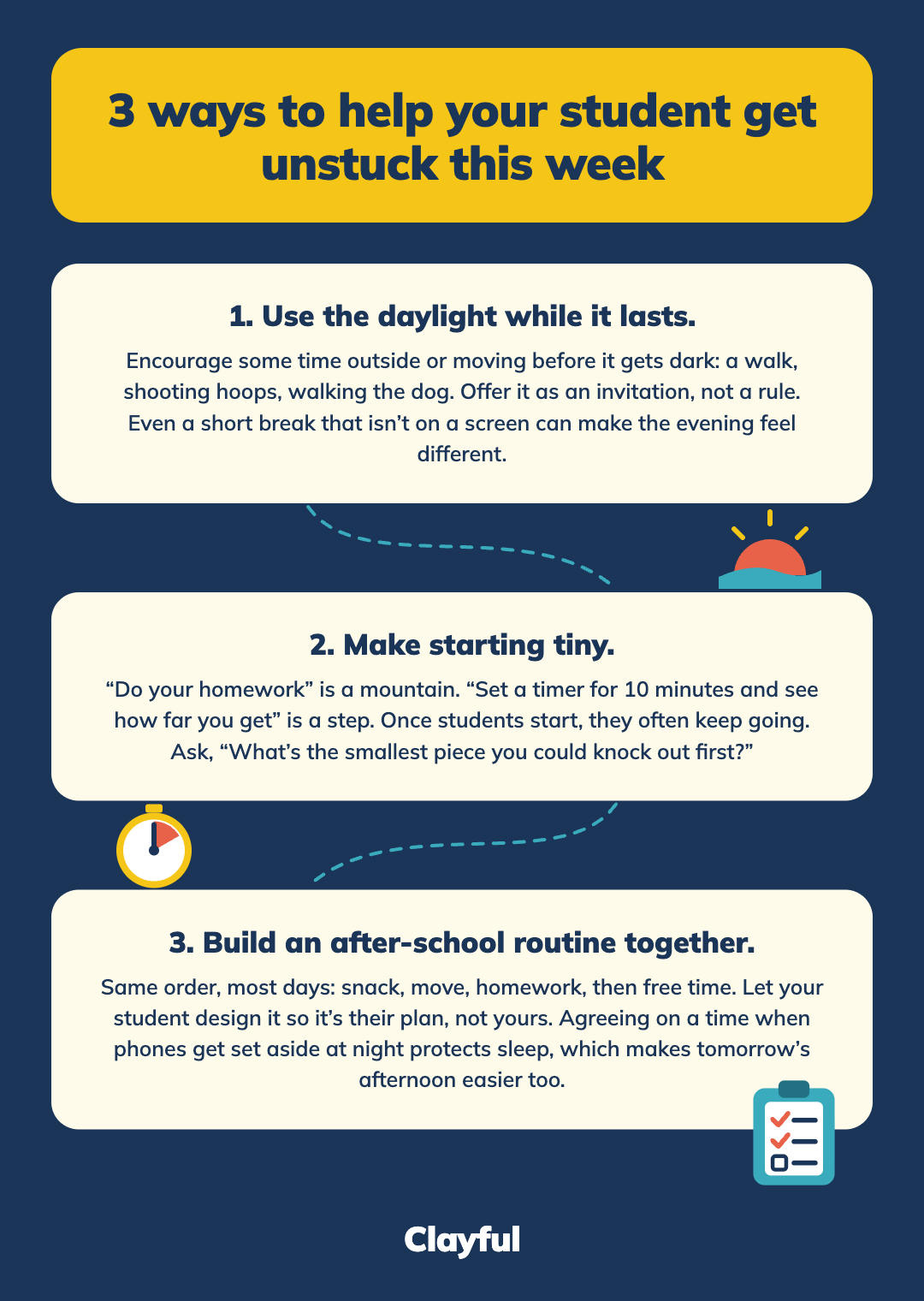
1. Use the daylight while it lasts. Encourage some time outside or moving before it gets dark: a walk, shooting hoops, walking the dog. Offer it as an invitation, not a rule. Even a short break that isn't on a screen can make the evening feel different.
2. Make starting tiny. "Do your homework" is a mountain. "Set a timer for 10 minutes and see how far you get" is a step. Once students start, they often keep going. Ask, "What's the smallest piece you could knock out first?"
3. Build an after-school routine together. Same order, most days: snack, move, homework, then free time. Let your student design it so it's their plan, not yours. Agreeing on a time when phones get set aside at night protects sleep, which makes tomorrow's afternoon easier too.
Sometimes you try all of this and the same conversation keeps circling. That's when it can help to have someone else in your student's corner.
If your student's school partners with Clayful, they can chat with a Clayful coach Monday through Friday, 8 AM to 10 PM. They don't need an appointment. Students reach out when something's on their mind, like a tough grade, a friend thing, or a rough day, and a trained coach helps them sort it out and land on a next step. For a student like Sam, that might mean making a game plan for tonight's homework or figuring out why afternoons keep slipping away.
Invite your child to explore what Clayful can offer by going to www.chatwithclayful.com. They will sign up with their school email if they haven't used Clayful yet, or they'll simply log in.
Caregivers can also take advantage of Clayful and receive coaching. Email families@clayfulhealth.com if you'd like to create a free account.
Not sure if your school partners with Clayful? Ask your school counselor.
If your student goes to a California school partnered with Clayful, they can also get video coaching: one-on-one sessions with their own coach, the same person every time, so they can go deeper.
Video coaching may be a good fit if your student:
Sessions are 50 minutes and can be weekly, every other week, or whatever pace fits their goals. They're booked ahead of time, and the video link arrives by email. We recommend scheduling after school so your student can join from a quiet, private space.
For Sam, a coach might help design an after-school routine that actually sticks, set one small goal for the week, and check in at the next session on what worked and what didn't. Having the same person follow up each week is often what turns a good plan into a habit. Between sessions, Sam can still chat with a Clayful coach anytime during chat hours.
Every student deserves someone in their corner, no matter where they go to school. Clayful partners with school districts to give students one-on-one coaching in the life skills that matter for school, college, and career: setting goals, managing their time, handling pressure, working through conflict, and making big decisions with confidence. We’re here to back up the work families and schools are already doing.
This is coaching, not therapy. Coaches help students set goals, build skills, and follow through. They don’t diagnose or treat. Clayful works alongside your school counselor, never in place of them, and if your student needs more than coaching, we help connect them to the right support.
Fewer than 1 in 10 applicants become Clayful coaches. Every coach is:
Will my family be charged anything? No. Through California's Children and Youth Behavioral Health Initiative (CYBHI), coaching is provided at no cost to your family. Health plans can't pass costs on to you: no co-pays, no deductibles, no higher premiums.
Then why are you asking for my insurance information? CYBHI lets schools be reimbursed for wellness support through families' health plans, including Medi-Cal. To do that, the district needs your consent and your student's insurance information. Sharing it doesn't mean you'll get a bill, and your student's access to coaching doesn't depend on whether reimbursement goes through.
Will this affect our coverage or care outside of school? No. Your coverage stays exactly the same. California law bars insurers from charging co-pays for CYBHI services or changing your coverage because your student used them.
Next week: the holidays are coming, and stress can show up at school, with friends, and at home all at once. Here's how to help your student handle more than one thing.