How it works
Lessons, coaching and screening for every student, launched and supported by our team.
Here’s exactly what that looks like for your district.

The DETERS framework
The same skills teachers and families see students struggle with every day.
We call them DETERS, because together they help deter a crisis before it starts. Lessons teach them, and coaching helps students use them when it counts.
Digital literacy
Using tech on purpose
Durable skill: Metacognition and critical thinking
In class
The phone wins over the lesson.
How Clayful builds it
Lessons on screen habits, plus the Habit Breaking Tool.
What you’ll notice
More present and focused in class.
Emotional regulation
Staying steady under pressure
Durable skill: Fortitude
In class
Freezes on a test, or melts down after a bad grade.
How Clayful builds it
A weekly lesson, plus coaching tools like the Grounding Tool and Top 10 Ways to Pause.
What you’ll notice
Recovers faster and gets back to work.
Time management
Managing time and focus
Durable skill: Metacognition
In class
Work piles up and they can’t get started.
How Clayful builds it
Lessons on planning, plus tools like Brain Dumps and Focus & Get More Done.
What you’ll notice
Starts tasks sooner and turns work in.
Effective communication
Working through conflict
Durable skill: Communication and collaboration
In class
A tough moment with a friend spills into the lesson.
How Clayful builds it
Practice with a coach on what to say, plus tools for handling gossip and other people’s feelings.
What you’ll notice
Fewer disruptions, students talk it out.
Resilient problem solving
Solving problems
Durable skill: Critical thinking
In class
Gives up as soon as they get stuck.
How Clayful builds it
Coaches help students break problems into steps, like the Ways to Prepare for a Test tool.
What you’ll notice
Tries another approach before shutting down.
Self-motivation
Getting motivated
Durable skill: Growth mindset
In class
Checked out, asking “what’s the point?”
How Clayful builds it
Goal-setting with a coach, plus the Positive Self-Talk tool.
What you’ll notice
Sets goals and shows up more.
They helped me find a way to study to get my GPA up.
Portrait of a Graduate
Fits your Portrait of a Graduate
Every skill students practice with Clayful maps to the durable skills on your district's graduate profile.
76%
of job postings ask for these durable skills
Source: America Succeeds and Lightcast, Durable by Design, 2025
What students get
Every week
Clayful Connection
Plug-and-play lessons that drop right into advisory or homeroom. No prep, no teacher script needed.
Anytime
Chat coaching
A trained human coach in under 60 seconds, on any school or personal device.
Fall, winter, spring
Screening
A brief check-in for every student that surfaces early distress.
For a deeper connection
Video coaching
Recurring 1:1 sessions with the same coach, before, during or after school.
Inside the app
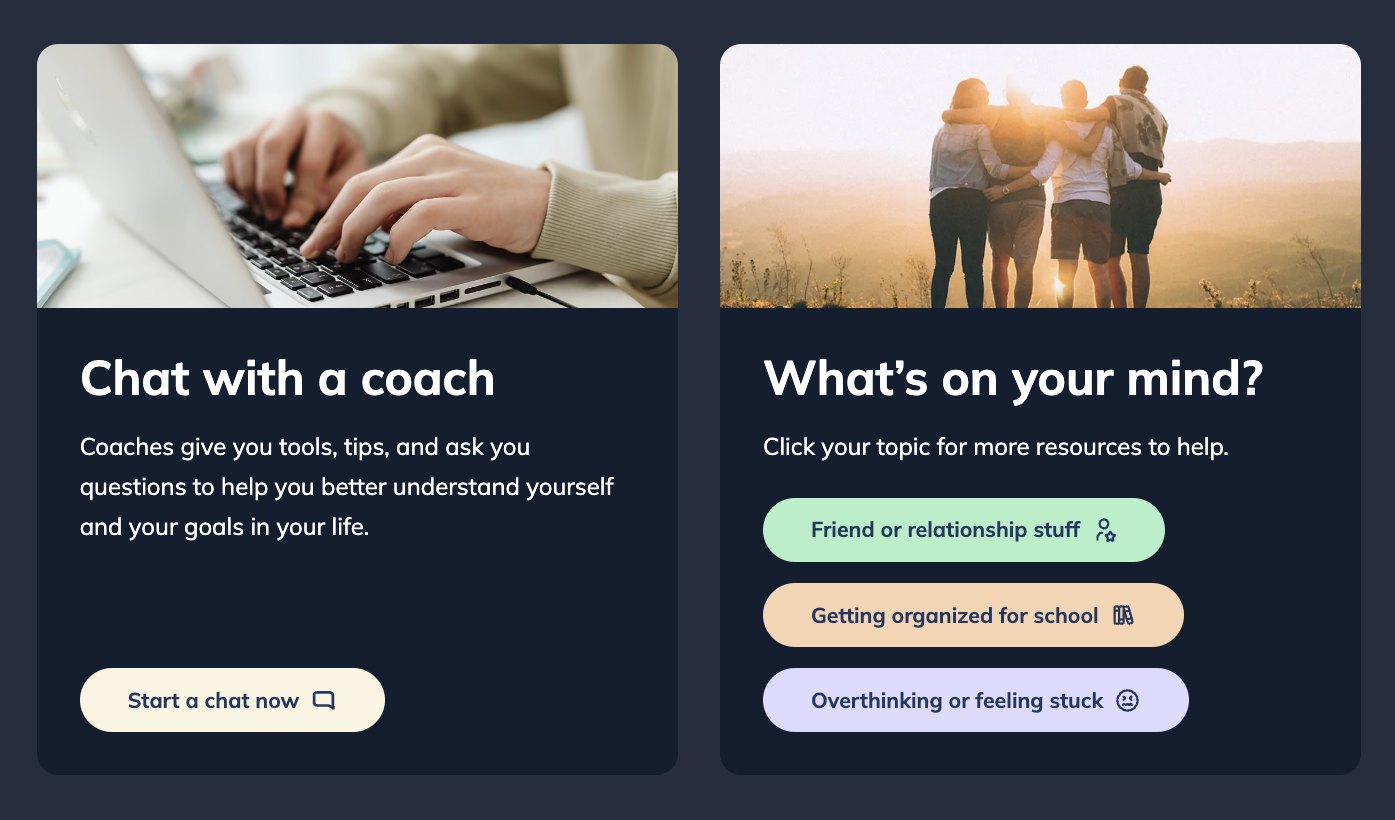
Students open Clayful on a school Chromebook or their own device and chat with a real, trained coach. Between chats, they keep practicing.
A lot of students at first were skeptical because they thought it was AI. But as they logged on, they realized, 'Oh, I'm talking to a real person.'
The launch plan
1
Team kickoff
We set goals, sites and the weekly schedule with your district team.
2
Staff training
A short session, live or on demand, so staff know how to use Clayful.
3
Family communication
We provide ready-to-send letters and consent forms, including in Spanish.
4
Student launch
Students log in with their school email in class and meet a coach.
All year
See what’s happening in every school, as it happens
Live dashboards
Usage and screening results by site, so you know where support is landing.
Top coaching topics
What students are talking about, so your team can respond before it grows.
Quarterly data talks
We walk your team through the trends and what to do next.
Your team’s role
Teachers
Open Clayful Connection lesson in advisory. That’s it.
Students do the lesson, then chat with a coach.
Counselors
Get notified when a student needs more support.
Use screening data to triage, plan, and prioritize.
District lead
Join the kickoff and quarterly data talks.
We handle setup, training and reporting.
“
It's very useful when there's a conflict. In the past, we would have had to stop what we were teaching to deal with it. Now it's, okay, go on Clayful and talk to a coach to find some strategies to regulate. That's been super helpful.
Escalation
Step 1
A coach notices risk
Coaches are trained to spot signs of harm in a conversation.
Step 2
A supervisor steps in
A licensed clinical supervisor is on every shift and reviews it live.
Step 3
Your team is notified
We follow clear protocols and contact the school or family immediately.
Step 4
Students get the right care
Your counselors and clinical team take it from there.
I didn't know what I was going to do tonight. I forgot I had Clayful, and then I started typing, and I didn't do the bad things I thought I was going to do. So thank you for that. I hope you know you're amazing and very appreciated.
For counselors
A quick wellness check-in shows where every student stands. When a student is flagged, your counseling team gets a clear list to follow up with and reach out to the family.
This is amazing. I'm holding my excitement in with all this data.
Distress levels
Fall check-in · 600 students
Flagged for follow-up
18
Counselors notified
Our coaches
<10%
of applicants make it through our selection process
ICF-certified
Trained in CBT-informed methods and motivational interviewing.
Background-checked
Every coach, before they ever talk with a student and throughout their work with Clayful.
Varied backgrounds
Former teachers, counselors and parents. All with experience in mental health and/or education.
FAQ
Students text a trained human coach in real time and connect in under 60 seconds, on any school-issued or personal device. Coaches are available Monday–Friday, 8am to 10pm. See how it works.
Yes. Every Clayful coach is a real, certified human being, never AI. Coaches go through an extensive interview, evaluation and training process before their first conversation. Meet our coaches.
Fewer than 10% of applicants make it through. Coaches include former teachers, counselors and parents. Every coach is certified, trained in Clayful’s methods and supervised by a licensed clinician. Meet our coaches.
School stress, friendships, family stuff, confidence, routines, sleep, big decisions and tough conversations. Students can also come with something small, like planning their day. It all counts.
No. Clayful is coaching, not therapy, and coaches don’t diagnose or treat mental health conditions. Coaching helps students build the skills they need to succeed: handling stress, working through conflict, staying motivated and speaking up for themselves. Learn how coaching works.
Chat conversations last as long as students need, from a quick check-in to a longer talk. Video sessions usually run about 50 minutes, and students can end early anytime.
As often as they need, Monday–Friday, 8am to 10pm. Many students check in weekly in advisory and reach out on their own in between.
Any school-issued or personal device, including Chromebooks and phones. Students can also download the Clayful app on their personal device at clayful.co/app-download
Yes. Clayful is provided by your school or district, so there’s no cost to students or families.
Yes. Coaching is confidential, and a licensed clinical supervisor is on every shift. If anything concerning comes up, we follow clear protocols and contact the school or family right away. Visit our Trust Center.
Our clinical supervisors step in, and the school or family is notified so the student gets the right next level of care. Read about our safety approach.
We’re happy to help. Email us at help@clayfulhealth.com and our team will get back to you.
20 minutes, a plan for your sites, and your questions answered.
